Showing posts with label environmental issues. Show all posts

Wednesday, January 22, 2014

From the "less waste" files

A short blog to get back in the habit of writing. [edit: It started as a short blog, but obviously, I am not capable of "short." No jokes about my stature, please.] I've been busy with my work, which also involves quite a bit of writing and social media content, so I've neglected my own writing. But I'm going to try to post shorter pieces just for the sake of getting the thoughts out of my head and on to the page. After all, that's why I write this: To clean out the thoughts rattling around screaming, "Write me down!"

On to a few short items about putting sending less stuff to the landfill. It's sort of a personal challenge to me to see how little stuff I can put in the garbage. Reduce, Reuse, Recycle.

1. Why is it so difficult for even smart, well-educated, Madisonians - i.e. people who should know how to recycle and why it's important - to figure out how to out a bottle or can in the recycling bin? I work at the UW, and pretty much every hallway has blue bins prominently labeled as "bottles and cans" or ""paper and newspapers" at each end of the hall. There are also recycling bins in many offices and break rooms. Yet I consistently find cans and bottles in the trash.

I'm not going through the trash looking for these things. I'm walking down the hall to the bus, and there outside an office is a small bin to be emptied by the cleaning crew: Plastic shrink wrap from a shipment, take-out container, coffee cup, a few napkins or paper towels, an apple core, and a soda can or bottle. Why? Why is it so tough to put that can or bottle in the container just steps away?

2. On a more positive note, I recently was reminded of Terracycle, a service that will take a lot of items that might either be cluttering up your house or going in the trash. They will turn your trash and clutter into either new items or rehabilitate what you send: Pens that don't work, old shoes, wrappers from energy bars, cereal and cracker bags, Britta filters, toothbrushes and toothpaste tubes, and lots more. It has eased my conscience to be able to bring those things in to work and have a place to recycle them instead of tossing them in the trash, or worse, hanging on to them out of guilt. ("Yeah, that pen doesn't really work very well, but it works sometimes, I shouldn't just throw it out. And that old toothbrush could be used to clean my bike or for other cleaning jobs. I should hang on to that.)

Someone in our office collects all the stuff and sends it in once a month. Terracycle will even send you the shipping label. If you have enough of certain items, you can designate a charity to receive a small donation. I'm sorting through all the old pens that don't work, the worn our shoes, and saving my wrappers to send in.

3. As I was brushing my teeth yesterday, (Why do great ideas always come to us when we can't write them down?) I started thinking about the beer bottle caps I'd been saving for a friend. He had told me that someone he knew was collecting as many types of bottle caps as he could. My friend knows that I like to try out different beers, so I might have a wide variety of breweries I could contribute. So I have a small bar of caps to give to him.

But then I started thinking about all the other bottle caps I'm throwing away. They are metal, so why can't they be recycled? So, being a good researcher, I Googled it. The first page I found was very useful - with photos! It said that metal bottle caps are steel, and can be recycled, but not just thrown into the bin as is. The problem is that they are very small, so they fall through the screens at the sorting center [video of how they sort materials with machines - actually pretty cool] and the caps never make it to the magnet that picks up steel. Recycling Week confirmed the problem and the solution.

But these two pages suggested a solution, which City of Madison Recycling Guru George Dreckmann confirmed is the way to go. (I was sort of proud of the fact that I actually provided him with this solution, which he had not thought of.) Put the caps into a steel can - like the ones that hold soup, tomato sauce, canned veggies, etc. Crimp the top so that the caps don't fall out, and then put that whole thing into the recycling. It's all steel, and that whole can will be picked up by the magnets. Do NOT use an aluminum (soda) can, because that would be mixing different kinds of metal, which is a no-no.

4. Finally, I am constantly amazed by people that stop composting in the winter. I understand not wanting to hike to the back yard in deep snow and bitter cold - both of which I did this morning to reach the compost bin with my just-about-full kitchen container. But on the coldest days, you could just dump it into a bucket outside the back door until the snow melts or the temps get more reasonable. That's what I did every year until I forgot to empty said bucket of ready-to-use compost before winter descended.

And besides, I like being outside, and emptying the compost is a chance to follow the bunny tracks to the back of the yard to where I know they are hiding in the brush pile.

But most people seem to think that they can't compost because everything will freeze. And yes, most of the pile will freeze, but not all of it. You'd be surprised how much of the pile is actually not frozen, sitting there creating heat for whatever critter has crawled in. Besides, it will all thaw out eventually, and then all those coffee grounds, bits of veggies, and stale bread will be ready to start over.

Oh, and one more thing I've started throwing in the compost: Kleenex. I usually get one bad cold a year, usually in winter, and go through almost a whole box of tissues in a short period of time. And then there is the normal nose blowing from dry air and cold outdoor temperatures. Instead of throwing it in the trash, I pile it into the kitchen bins and then the backyard pile.

It all just disappears into the compost. I have yet to find any paper left when I'm ready to throw it into the garden. Corncobs will still be there, along with bits of tough stems and other plant material that takes longer to degrade. But that can just go back into the bin for another round.


Wednesday, January 11, 2012

The most dangerous consumer product in the US

This AZ press release makes some very good points about driving and road safety. As I am fond of saying, "If any other consumer product had this sort of safety record, it would be pulled from the market within a week."

When I say things like that, people point out that the majority of Americans either drive or ride in a car every day, so it's not surprising that we have a few deaths. OK, let's look at this another way. What if 30,000+ people were killed every year using a computer, or a credit card? Those are some pretty mundane task that tens of millions - maybe more than a hundred million - of people use every day. Would we accept someone using a computer dying every 15 minutes? Would we accept 30,000+ people dying from turning on the lights in their homes or making coffee?

Why is it acceptable to lose this many people every year by motor vehicle? Especially when the majority of those deaths could be easily prevented by making sure that people take driving seriously. No, you can't talk on the phone. No, you can't drink alcohol. No, you can't go over the speed limit. Not OK. A motor vehicle is a large, complex, dangerous machine, which is why we require people to have a license to operate one.

In many countries of the world, getting a driver's license is hard and expensive. And losing one is easy. In some European countries, you can lose your license for a year if you get your first DUI, and if you get three, ever, you will never be issued a license again, for the rest of your life.

Yes, we make it easy to get a driver's license, and hard to lose it, in this country because most people have no other way to get around, if they can't drive. Children can't get to school, unless their parents drive them. People wouldn't be able to work, shop, visit friends and relatives, see the doctor, or otherwise do normal activities. Of course, 30% of the US population doesn't drive, but they are considered some sort of freaks, those too young, too old, too cheap, too frail, or too environmentally conscious to drive or own a car.

But we need to rethink this whole transportation thing. People shouldn't be trapped in their cars to live, work, and move about. It's too expensive - for both individuals and taxpayers, too unsustainable - in so many ways, and yes, too dangerous to have everyone doing it.

My mantra: "Driving should be a choice, not a requirement."

Friday, January 21, 2011

Walker kills biomass at Charter St plant: Again penny wise and pound foolish

Too bad that saying is using British currency, because "penny wise and dollar foolish" just doesn't sound quite as catchy. But the wisdom behind it is still the same. You can save a little money now, but find out that your savings are short lived, and you end up spending more money over the longer term.

Yesterday's announcement that our new Governor is finally killing the biomass boilers on the new Charter Street heating plant is just this kind of thinking. He's crowing about saving the Wisconsin taxpayers $100 million by not including the option to burn biomass, as well as natural gas. But heating plants last many decades, and we don't know what the price of natural gas will be in 2020, 2030, or 2050. We are passing up a chance to build a heating plant that could switch its fuel based on the prevailing price, and the fuel could come from right here in Wisconsin, instead of far away via a pipeline.

This power plant will sit on the University campus, a campus that is in the forefront of research on biofuels of all kinds. We are an agricultural state with lots and lots of biomass of all kinds, including waste from agricultural products, street and highway brush cuttings, waste from lumber and paper production, and naturally occurring plants that need virtually no fertilizer, irrigation, or cultivation. Wisconsin is in an ideal situation to both produce biomass and do the research to make sure that the plant is both energy and economically efficient and sustainable.

(How ironic that the Wisconsin Bioenergy Institute announced a grant program the day before Walker pulled the plug on a coal to biomass conversion on the UW campus. The grant they announced seeks a small, older coal or oil-fired facility in northern Wisconsin that could be converted to biomass.)

But that's all gone now. No jobs producing biomass. No home-town heating plant to test the efficiencies. No flexibility in fuel source, should natural gas prices soar. Less fuel security from a local source. All that design work down the tubes.

This seems to be the hallmark of the new Walker administration: It doesn't matter that a project has been planned, designed, voted on, budgeted, and started, we need to kill it if it will save a few dollars next year. it doesn't matter that this project will create jobs here in Wisconsin, if the left likes it, or it benefits Democratic strongholds like Madison and Milwaukee, kill it. Even if the project will possibly save billions of dollars in the next thirty years, we can't afford it now.

This is the sort of thinking that has gotten corporate American into so much trouble: Think only of the next quarter and the dividends of the investors next year. Forgot long term investment that may pay off in ten years, leave those to the Europeans and Asians. We can always play catch-up.

Intercity trains. Biomass heating plants. What's next?

I've been thinking of an analogy that individuals might understand, a decision they might make to save a little money now, but that will mean possibly decades of lost money down the road. Not too many things we purchase can't be changed, sold, or upgraded. If a pair of shoes falls apart, because we saved a little money, well, we are out the price of the shoes. We all know that buying the cheap brand isn't always a bargain.

But as I sit at home, on this frigid morning, in my drafty 1922 house (which I generally love), I think I found the right analogy. I replaced my old, wooden storm and screen windows about 15 years ago. I was tired of climbing up on the ladder each spring and fall to physically change the heavy outer windows. The screens were ripped on some of the frames, and it all seemed too much trouble. I replaced them with new, combination storm/screens, ones that I could slide up and down from the comfort of my house. But I didn't get the really energy efficient, double pane, expensive windows, because I was tight on money. Natural gas was cheap, and I have lived in drafty houses my whole life. "No big deal," I thought, "How bad could it be?"

Pretty bad. Now, because of my decision to save maybe $1000-$1500 on the whole house, my heating bills are hundreds of dollars more each year, and the cost of replacing those windows has skyrocketed by thousands of dollars. But I could actually still replace the windows.

Now imagine building a whole house that is drafty and poorly insulated from the start. Sure, it would be cheaper, but those heating bills would eat up your savings pretty fast. And your heating fuel might get even more expensive. Then you'd be faced with continuing high heating bills, or going back to do an expensive fix, like adding insulation and new windows. Wouldn't it be better to build it right the first time?

Penny wise, and pound foolish, Governor Walker. I hope the people of Wisconsin remember who killed the train and the flex-fuel heating plant. We'll have a new governor by then, but your decisions will be a burden on us for decades.

Tuesday, November 30, 2010

Wisc-Minn hearings on possible rail routes between Milw and Twin Cities

Dates for meetings at the end of this post. Also note the change of venue for the Madison hearing.

Photo courtesy of Environmental Law and Policy Center
No, rail is not totally dead in Wisconsin. Even though Gov-elect Walker is determined to throw away $810 million of federal investment and thousands of jobs to stop the extension of the Hiawatha service between Milwaukee and Madison, Wisconsin and Minnesota DOT officials are moving forward with a series of meetings to study routes through Wisconsin to Minnesota.

Coming up this week and next these meetings that give us a great chance to show support for rail in Wisconsin. Unfortunately, the info about the meetings is hard to come by and confusing for anyone not already deep in the rail debate. There isn't even any information on the WisDOT web site, and they are running the meetings!

This is my effort to put all the info in one place.

Apart from the $810 million in ARRA money granted to Wisconsin to extend the popular and successful Hiawatha line west from Milwaukee to Madison, there was another project funded - a study of the best route between Milwaukee and the Twin Cities. This was a joint study between the Wisconsin DOT and the Minnesota DOT, but Minnesota is taking the lead. Each state put in $300,000, and the federal government kicked in $600,000, so the study has $1.2 million total.

If the Hiawatha extension moves forward, that is, if Walker allows the Milwaukee-Madison piece to be built, it would seem logical for the MN-Milw route to go through Madison. But there are actually 14 routes being studied, and three of them do not pass through Madison. However, according to today's Milwaukee Journal-Sentinel:
Wisconsin transportation officials don't believe any alignment that excludes Madison would be economically feasible, but the study has to consider all options, said Cari Anne Renlund, executive assistant to Wisconsin Transportation Secretary Frank Busalacchi.
That is why we need to attend these meetings and say that we want rail in Madison. Also, one of the routes being studied is the current Empire Builder route that goes through Columbus, not exactly convenient to Madison, and certainly not likely to bring business or tourists to downtown for Badger games, Taste of Madison, Farmers Market, Art Far on the Square, etc. It's also not going to help business people that want to access the Capitol or campus area by bus, foot or bike. They are looking for a quick, easy way to avoid driving, and a Columbus stop really isn't much help.

However, the Walker has said he might consider using the federal stimulus funds for the Empire Builder. I guess he's willing to hang on to that money, as long as it is for a project that is guaranteed to fail and won't benefit those meddlesome liberals in Madison.

So let's get out to the meetings and show our support for rail in Wisconsin. This is about more than the much-debated Milwaukee-Madison piece. It's about economic development in western Wisconsin and connections to the entire region. Eau Claire and LaCrosse are both eager to have a connection to Madison and the Twin Cities. They know that this will bring investment in their communities and crucial connections to business and people across the Midwest. Minnesota wants a connection to Chicago, and they will push for it, even if they have to go through Iowa instead of Wisconsin. Illinois officials are already looking at that possibility.

Do we really want Wisconsin to be bypassed? Are we going to be the backwater of the upper Midwest, doomed to be off the map as modern transportation moves through other states, loaded with business deals, tourists, and investments? Are we willing to be left off the new interstate system?

Attend one of these meetings, and RSVP via the WISPIRG web site so you can get more information on how we can move rail forward in Wisconsin:
  • Tuesday, Nov. 30,  5-7pm: Best Western Riverfront Hotel, LaCrosse
  • Wednesday, Dec. 1,  5-7pm: Best Western Trail Lodge, Eau Claire
  • Thursday, Dec. 2,  5-7pm: University of Wisconsin, Fond du Lac
  • Tuesday, Dec. 7,  5-7pm: WisDOT Southwest Region Office, 2101 Wright Street, Crowne Plaza Hotel, 4402 East Washington Ave, Madison
If you can't make the meetings, but want to submit comments, you can do so until December 29 by sending them to the MN DOT:
praveena.pidaparthi@state.mn.us

Friday, October 1, 2010

A personal victory in a recycling sign

The sign to the right I consider a personal victory. It's at a downtown chain restaurant (Cosi) that I occasionally patronize. For a couple of years, it bugged me that there was no place to put my recyclable bottle or can. Madison ordinance requires that there be a place to recycle containers, and both Dane County landfill rules and state law prohibit placing recyclable materials in the landfill.

Saturday, September 25, 2010

Connecting people and food - Madison has it good

During my conference in Chattanooga, I participated in a mobile workshop - a chance to get out and see the city and discuss issues - called Connecting People and Food. Since I have been interested in food politics for awhile, I thought I'd see what the folks in Chattanooga felt were their local issues.

Friday, July 23, 2010

Free food on Fridays - delivered by bike

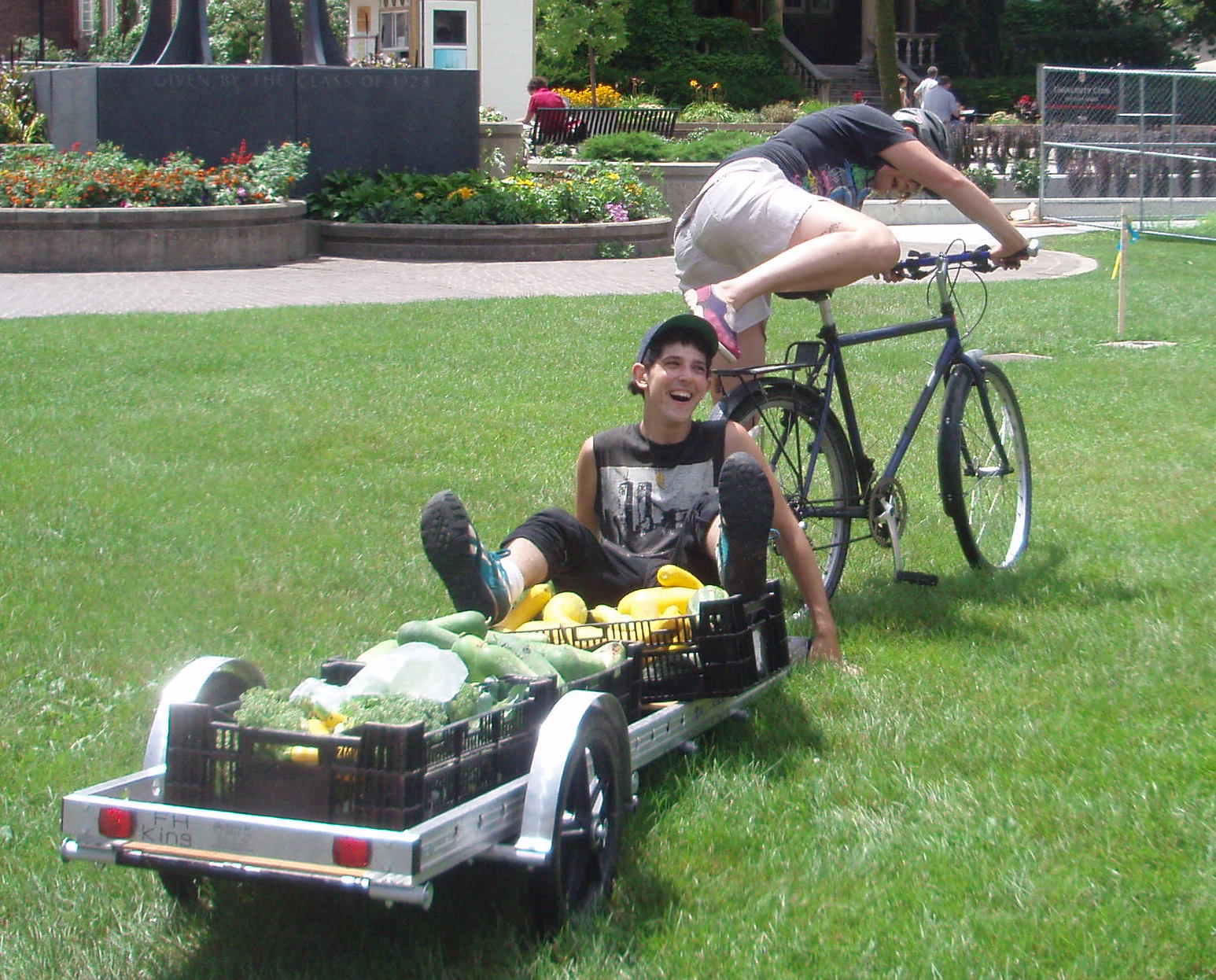
Yummy fresh produce, courtesy of the folks at the F.H. King Student Farm, is delivered by bike and given away each Friday at 1 PM on Library Mall.

I think I heard about this, and then forgot until today. There I was, enjoying a little lunch from the food kiosks, and here comes a woman on a bike, with a long bed trailer and eight 18-gallon plastic totes full of fresh produce.


Within a couple of minutes, more people come by with more veggies, a table and banner.

I had just stopped to take a few photos of how much stuff can be carried by bike, and asked what was up. "Oh, we give away produce every Friday."

I grabbed some great big bulbs of garlic, since mine's not ready yet. And fennel, which in now making my backpack smell like anise.

Thursday, July 1, 2010

Bicycling changed Dave's life. What about yours?

Today I  want to link to another friend's great blog post on how a mountain bike saved his life. Dave Schlabowske is the "bike czar" of Milwaukee, and someone I consider a friend. We worked together back when we were both at Bicycle Federation of Wisconsin, and I always found Dave an interesting guy and fun to be around.

He's one of those people that has had several careers that don't seem linked at all. I'm like that a bit myself, but that's another blog post.

What I love about this his story, laid out in the link above, is that owning and riding a bicycle transformed his life, physically, professionally, and mentally. He found his calling, or maybe his second calling, changed career paths, and made some changes in his life that he feels literally saved his life.

We never know what decision today will take our lives in a different direction or have deep meaning years down the road. Bicycling has certainly led me to where I am now, and I have heard many stories from others about how it has changed their lives as well. That's why I love to help others learn to ride their bikes comfortably, safely, confidently.

Later today or tomorrow I'll have a link to a class I'm teaching in mid-July. It's a class I've taught many times before, but this time it's a women-only class. If you want to feel better riding your bike; if you want to be able to bike around town without worrying if there is a path; if you want to be able to enjoy your bike more, let me know.

But for now, I'm just going to link to Dave's great post. I have a bad cold (how is that possible when the weather is so nice?), and can only manage short bursts of productiveness.

Friday, May 21, 2010

Connecting green thumbs with food pantries

Photo courtesy of GetRichSlowly.org

In wandering through the news sites today, I came upon this article on cnn.com about a web site that connects gardeners with extra produce with food pantries that would love to have the abundance of your garden. AmpleHarvest.org allows people with too much bounty in the garden to find a food pantry that can take it off your hands. Almost every home gardener has been in that situation. Too many tomatoes, zucchini, even spinach, beans, and peas can get a little out of control.

Friday, April 23, 2010

Well Said: Our friend in Oregon tells off his state rep

 Hans Noeldner is fighting the good fight down south in Oregon (WI, for my friends in other parts of the US.)

Today he had an excellent letter to the Cap Times taking Rep Brett Davis to task for standing in the way of progress and a better, greener future.

Start with fresh ambitions for the lieutenant governor’s office. Shovel in supersized helpings of campaign funding from road builders, Wisconsin Manufacturers & Commerce, and petroleum interests. Whip to a froth with party ideologues desperate to thwart any progress for which Democrats could take some credit -- and the public interest be damned.
What do you get? Brett Davis trotted out in front of the cameras to torch clean energy jobs legislation. Davis spearheading efforts to derail 21st century train service in the highly congested Madison-Milwaukee corridor. Davis conniving to cripple fledgling steps toward regional transit authorities -- i.e., more local and regional control over local and regional issues. [more]

Read more from Hans at his blog, Entropic Journal.

Sunday, April 11, 2010

What happens to your tire treads when they wear down?

Eewwww. I knew this, but it's nice to have it in the paper, where everyone else can see, and think about it.

Just one more reason that single occupancy vehicles, especially large, heavy ones, are not good for our environment, health, or society. All those bits of tire? You are breathing them into your lungs. And the pieces that don't get breathed in eventually end up in our soil and water. That sounds benign until you read all the toxic compounds that are contained in those little bits and pieces.

The next question is, "Where does the asphalt go that used to be in the roadway?" You know, that part that gets worn down by all the trucks, cars, buses, etc. Where does that go? Pretty much the same place.

Sunday, January 17, 2010

Eagles return


"Take a good look at that eagle, because you may never see one again."

That is what my father told me whenever we would see a bald eagle as we canoed through the Boundary Waters or Quetico when I was very young. At that time, DDT was still being used in the US, and eagles were so rare in the lower 48 states, that my father warned us that they might be gone forever.

I have never forgotten his words, and still marvel at how common eagles are today. I have seen them perched on a light over University Ave, flying over Lot 60 on the UW campus, and frequently on the Wisconsin River. They have been removed from the Endangered Species list, and Wisconsin exports eggs to other states to help them boost their populations.

Seeing a bald eagles is still is thrill, with their seven foot wing spans, white heads and tails, and motionless, seemingly effortless soaring flight. But we are no longer telling out kids that they may never be able to see our national symbol in the wild, and to me, that is quite a thrill in itself.